A Guy Named Joe
Below is a story, written by my father – his own biography.
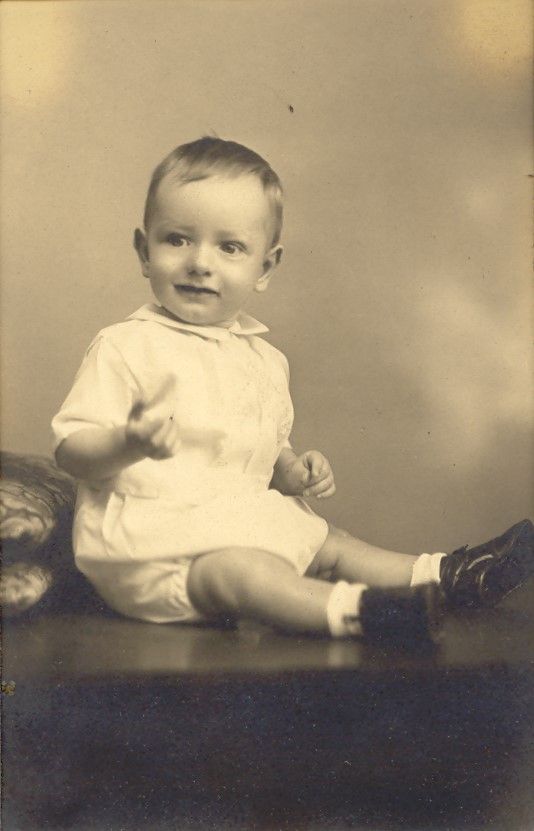
This is a story of a guy named Joe. Joe, that’s me. I was born on April Fool’s Day in 1932. I was born in a small hospital in a small town called Whitinsville in the southern part of Massachusetts.
When I was born, I was not a healthy baby. I had anemia and a heart murmur. I never was a healthy child growing up.
Whitinsville is a mill town of the Whitin Machine Works. Most of the people in the town and the surrounding communities worked at the Whitin Machine Works. My dad was one of the exceptions. He was a grocer/butcher in a small store near the Works. My early years were spent in a house that my father built on Sutton Street in the village of Northbridge. I grew up there and at the age of three, my brother Milt was born in that same house. My earliest recollection of that event was Milt crying and I said “Throw him out in the back yard”. Milt never lets me forget that quote.
At an early age, my uncle Marty built his house on the same street just a few hundred yards up the hill. At the age of six, I was sent to the hospital in the “big” city of Worcester, and had my appendix removed.
While on Sutton Street, my dad decided to build a screened in gazebo in the back yard. He made the walls of stones. The walls were about three feet high and the post, also made of stones, were eight foot high. The roof was timber and it was all screened in to keep out the bugs. The hill that our house was on also had thousands of stones. These stones were about the size of softballs and my cousin and I would take my wagon into the woods and load it up with stones and then roll down the hill to our house and deposit them near the gazebo. Dad would mix cement and proceed to make the walls and posts.

Because my Uncle lived just up the street, I was very close to my cousins. We would play together and would “work” together when my dad was working on the Gazebo and when Uncle Marty was adding a “sun” porch onto his house. In the summer we would play ball, football, hide-and-seek, etc., and in the winter we would slide and ski down the hill in Uncle Marty’s field. One day when the roads were covered with ice, we went sliding down the street and we went as far a mile away. Dad was kind enough to let us hook our sleds to the bumper of the truck and pulled us back up the hill.
In 1939 a hurricane visited Massachusetts and my mother and I waited anxiously for Dad to come home. It was well after dark when we saw him walking up the street in the rain and wind. A tree had been blown and blocked the street, so he left his truck and walked the last half mile to the house. We were so glad to see him. There were thousands of trees blown down in the woods of Southern Massachusetts.
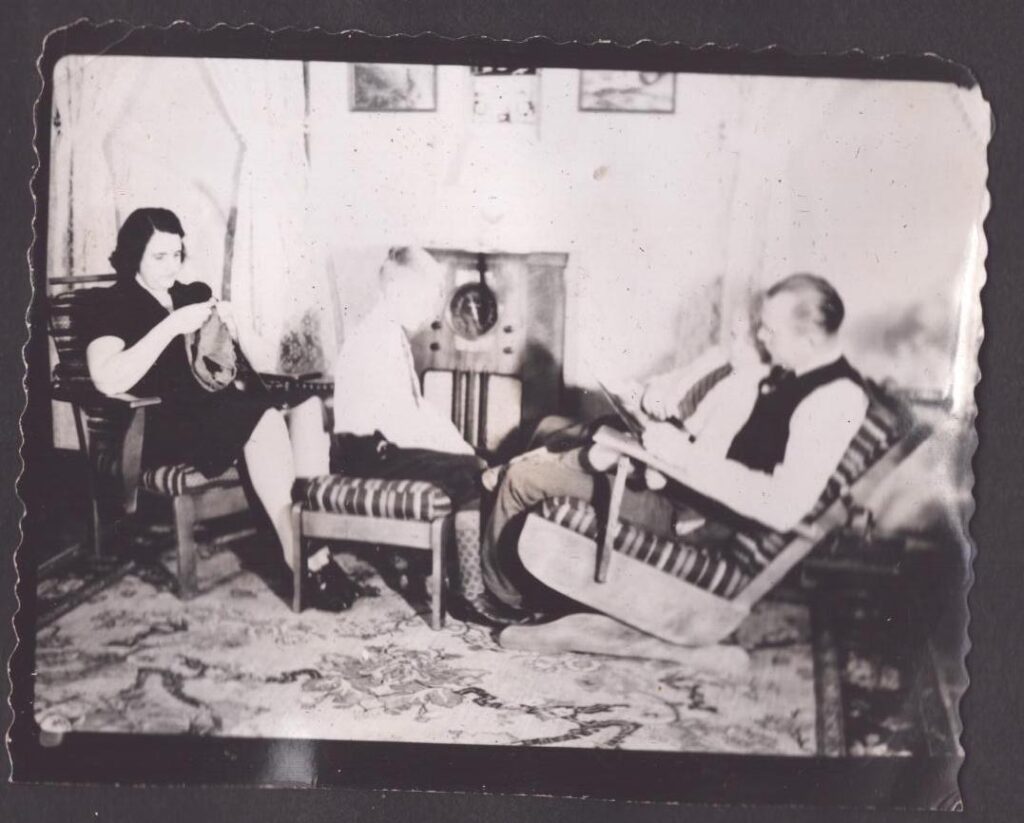
My dad and Uncle Marty would play chess in our living room on many Sunday afternoons. In the evening we would gather around the radio and listen to “The Shadow Knows” and other programs. TV was not invented yet. One Sunday afternoon while we were playing out in the yard, we heard President Roosevelt make that speech about the Japanese attacking Pearl Harbor. It was shocking and it changed our lives forever.
Shortly after that the Army was conducting training missions in the woods near our home and I remember a small plane flying above the street and I saw this object come out of the plane. It was a simulated bomb and when it hit the pavement it splattered flower all over the street. In a very short time several of my cousins were either drafted into the Army or enlisted in the Army or the Navy.
I can remember shortages and rationing and especially rationing of gasoline. Because my dad worked for the store, we always had food, and because he delivered groceries to hundreds of store customers, he always had gasoline.
In 1943 or 1944, Dad took a new job as superintendent of the Northbridge Infirmary and we moved to the farm. Dad was now a farmer. We grew many of the vegetables that were consumed by us and the residents of the Infirmary. We had cows for milk, chickens for eggs and meat, and pigs for meat. We supplemented this with some groceries from the local markets, but for all intense purposes we were self-sufficient. We had several fields on which we grew hay for the cows and my horse. Dad got me a pretty fast riding horse and in my spare time I would ride on the trails cut through the woods by the lumber companies that took out many of the trees that had blown down in the 1939 storm. I also had some riding friends that lived about two miles up the street from our house. One of them was in the Army and had seen action in Europe. He brought back a set of spurs taken from a German Officer and he gave them to me. I still treasure them.
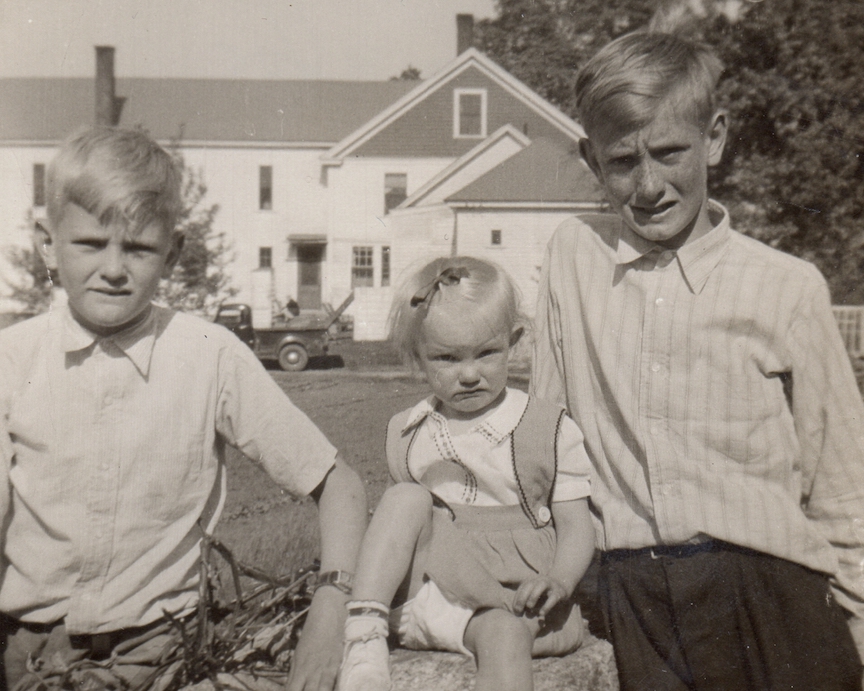
Because I was a young boy now and not just a kid, I learned to drive the tractor and also the pickup truck. I would drive the tractor while Dad rode the hay cutter. After the hay was cut we would rake it into wind rows and eventually load it onto a wagon that was connected to the tractor. I would drive the tractor up to the barn and then we would use the hay tongs to lift the hay up into the barn. The rope to pull the hay up was tied to the front bumper of the truck and when signaled by Dad, I would start backing up the truck to lift the hay into the barn.
I got pretty good at driving the tractor and the truck at an early age. One day when we had our chores done, Dad let me take the truck to the bridge/swimming hole just a half mile frown the house. We lived on a dirt road and there were no other houses on the street in that direction. While we were there swimming and having a good time the chief of police came down with his family to do some swimming. He spotted the truck and asked where Dad was. He and Dad were old friends. I told him I had driven the truck there and I was going to drive it home. He told me that if he ever caught me driving past the bridge where we were swimming, he would put me in jail. I believed him. I was only 14 years old.
When I was 16 my dad got a new job as superintendent of the infirmary in the town of Stoneham which was a little north of Boston. I enrolled in the Stoneham High School and went there until I graduated in the spring of 1950. During my school years I dated a very nice young lady named Natalie Johnson.
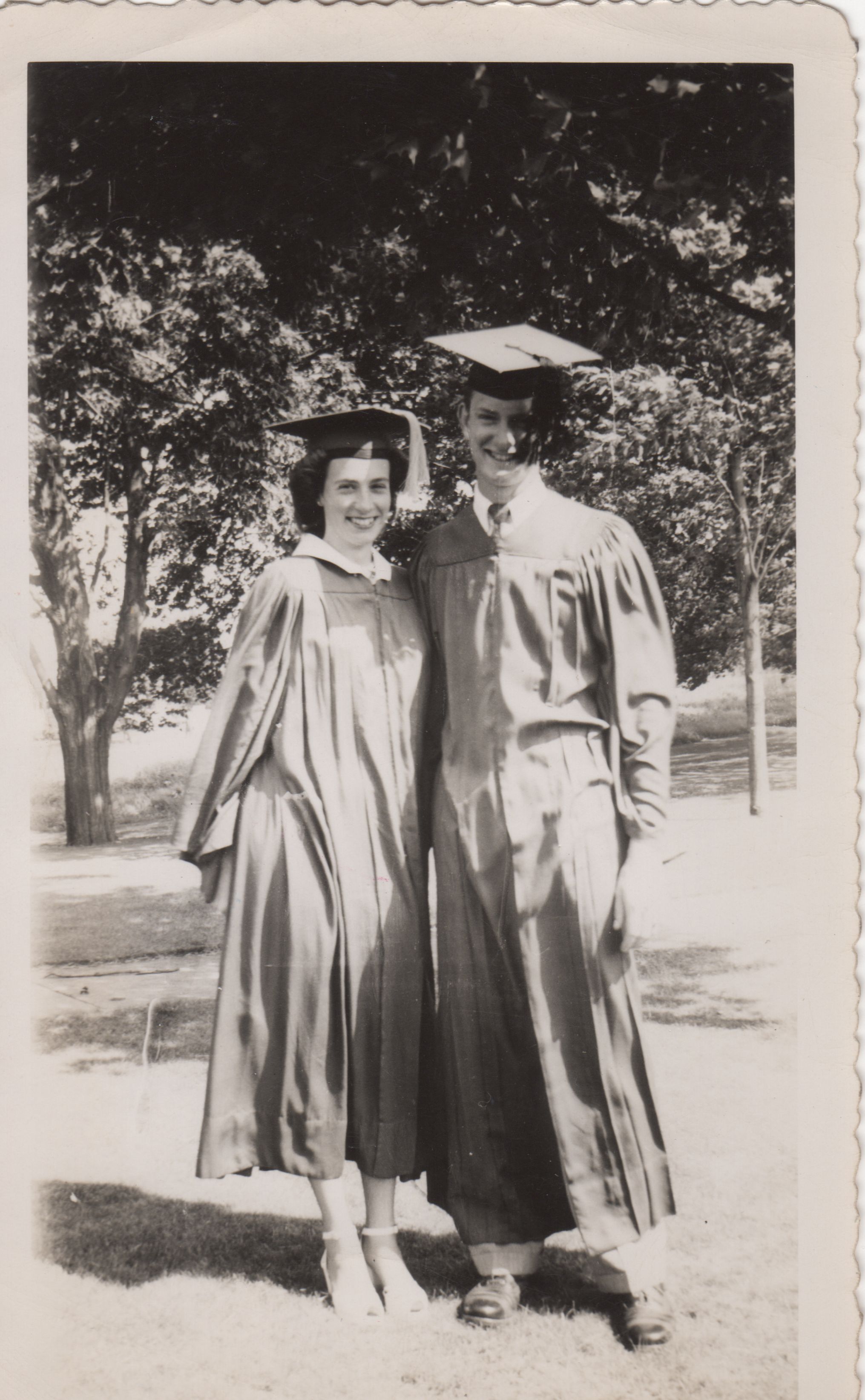
Natalie’s dad owned and operated a carnation facility. I worked, after school, for a man named Whittemore. He also grew carnations and Natalie and I would compare harvests every week. Natalie was my first love and we were a couple during my high school years. After graduation, I went to the University of Massachusetts and Natalie went to college in Boston and I lost contact.
I went to the U of M for one year and studied agriculture. Because I did not do well, I decided not to return for my sophomore year. I got a job working as a mechanics helper in the ship yard in Boston, and after working there for a little over a year, the draft for the Korean War was nipping at my heals. Instead of being drafted into the Army I joined the Air Force. I went to basic training in upstate New York, and after basic I went to Harlengen Texas for Aviation and Officer Cadet training.

I finished my training there and was transferred to Mather AFB in Sacramento, CA. I finished up my training there and got a commission as a second lieutenant and received my aviation wings as a navigator.
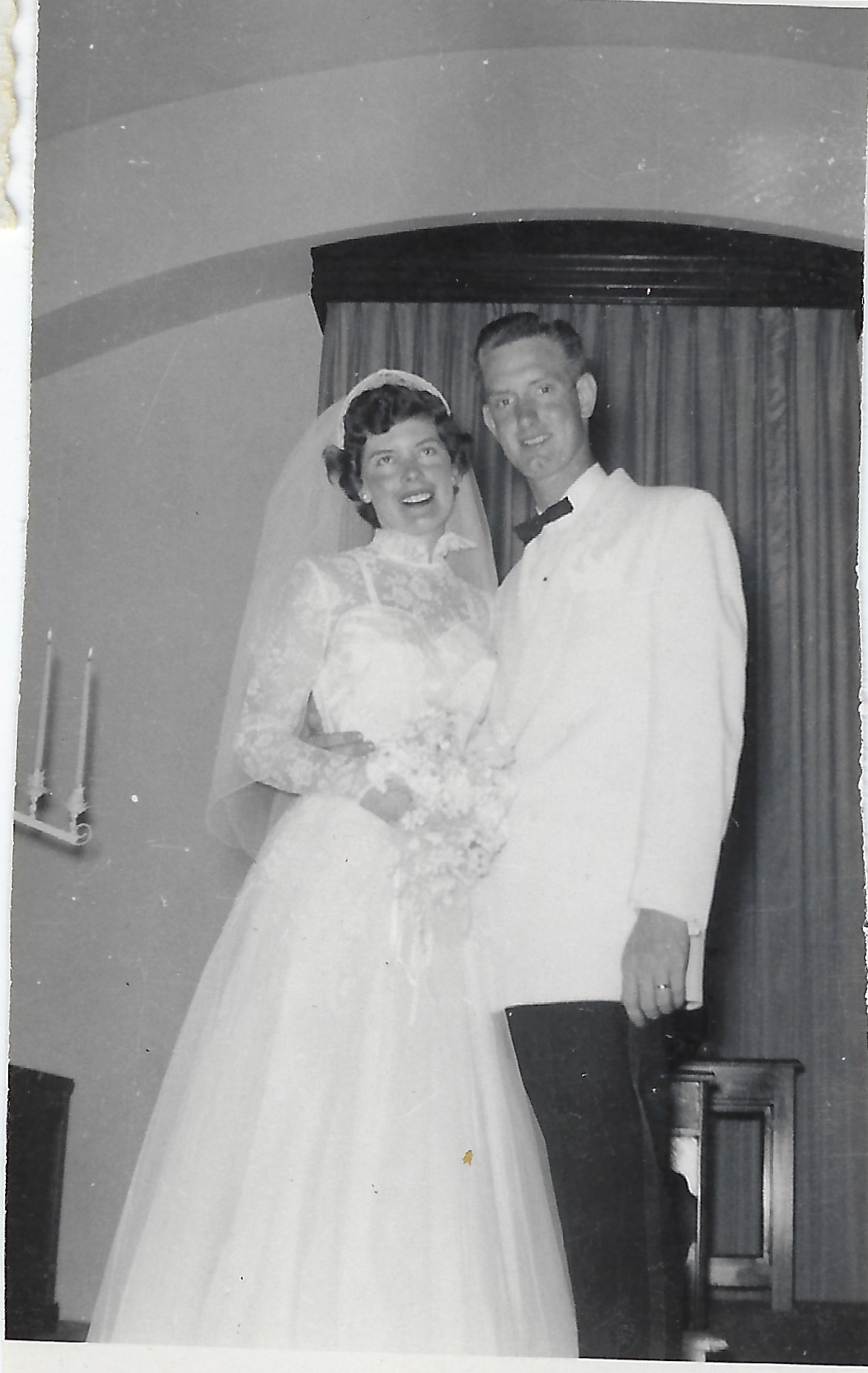
While I was in training in Sacramento my cousin who lived in Los Angeles invited me down to visit family. While there, he and his girlfriend set me up on a blind date with a lovely girl named Barbara Holm. We fell in love and married as soon as I finished my training.
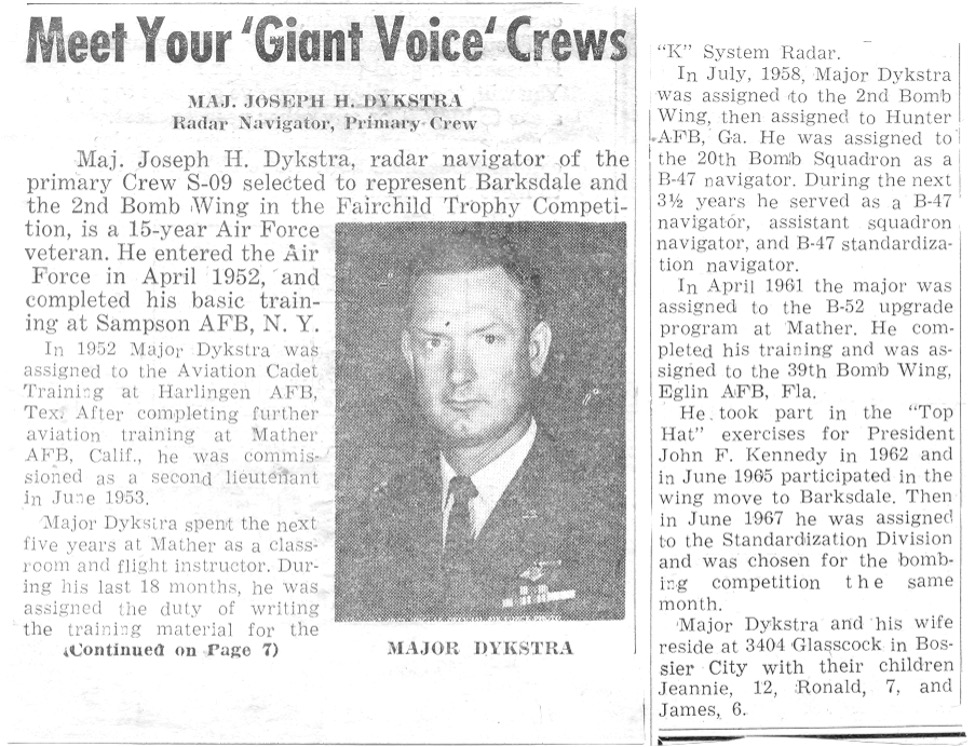
After my schooling at Mather, I was supposed to go to Langley, VA to be checked out in the twin engine B-26 bomber so I could go to Korea. The commander of the training school asked me if I would like to stay at Mather and become an instructor. Rather than going to Korea, this sounded like a much better position. I went to instructor school and in a short time I was teaching the radar navigation and bombing system used in the new jet airplane in the Air Force called the B-47 Stratofortress. I was an instructor in the classroom where I taught the electrical and mechanical systems of the bomb/nav system. I also taught in the air where we taught how to use the system in the air. I was an instructor for five years. During the last 2 years I was selected to write the training manuals for the students (for the “K” System Radar). While Bobbie and I were in Sacramento we had our first child – a daughter named Jeannie Lynne.

In 1958 I was transferred to Hunter AFB in Savannah GA. I was assigned to a bomber crew as the navigator in the B-47. We would fly training missions frequently and we would practice navigation, bombing and refueling. We would make simulated radar bombing runs of various cities in the US. The simulated bomb runs would be scored by a radar bomb scoring site on the ground, and after the run they would call back the expected impact score. One of our duties as a bomber crew was to be on alert with an airplane fully loaded with a nuclear weapon. We also would “pull” alert at an air base in England. Our bomb squadron would fly three aircraft in formation to England. We would fly our airplane to England and then it would be loaded with a weapon and put on alert.
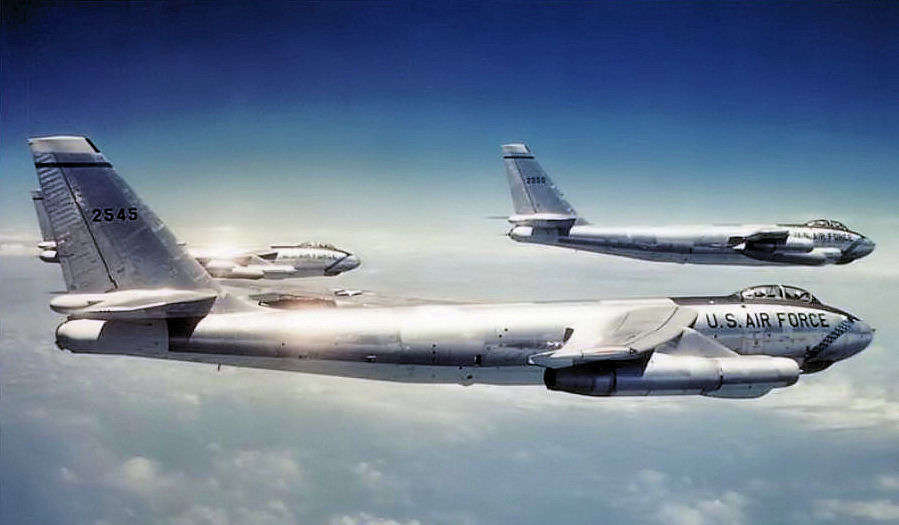
While there we would be on alert for one week and then off for a week and back on alert for the third week. After the third week, we would have our airplane unloaded and then we would fly it back to Georgia. We would always have to accomplish in-flight refueling on the way over and on the way back. After numerous tours in England, our squadron was assigned a new airfield in Morocco North Africa. We served several tours of alert in North Africa. I became a very good navigator and bombardier, and soon I was selected to become a lead navigator. I also became an instructor navigator. I also was assigned as squadron navigator and taken off a crew. I would teach the newer navigators and also check them out for crew duty. While at Hunter, my second child was born. A son Ronald Joseph was born on St. Patrick’s day in 1960.
In 1961 I was reassigned to B-52 training in California and New Mexico. While I was in training, my second son James Robert was born in Los Angeles on July 20. After I finished my training I was assigned to Eglin AFB in northwest Florida. I was on a B-52 bomber crew there for several years. While I was on alert with my B-52 crew the Russians were putting ICBM missiles in Cuba. I was on alert when President Kennedy made that speech to the American public about the missiles in Cuba. That night we launched two B-52s loaded with nuclear weapons and headed them across the Atlantic Ocean so they would be closer to Russia, if war broke out. My crew launched the next day and we were on our way over the ocean. We would refuel over northern Spain and continue out into the Mediterranean. We would go almost to Turkey and then turn back towards the US of A. We would refuel again over southern Spain and Portugal. After the final refueling we would head back to the South Carolina coast, and back to US of A.
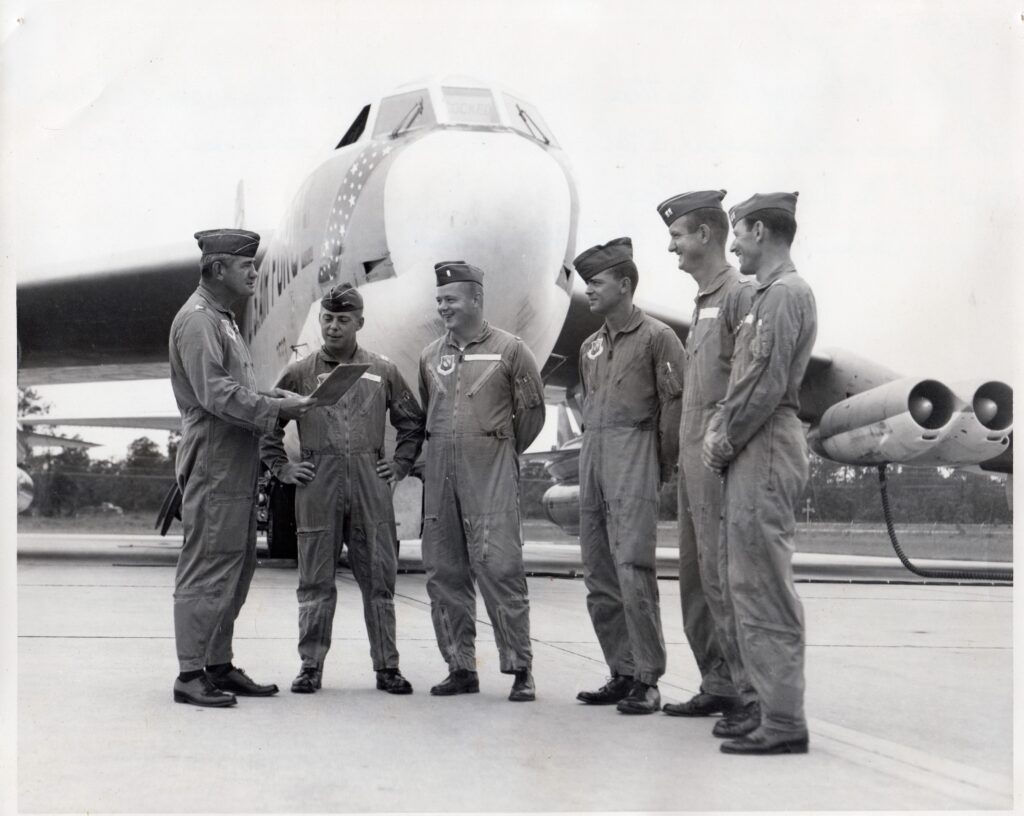
Eglin AFB, Florida, 1964
I was assigned to the 39th Bomb Wing, Eglin AFB, where in 1962 our crew took part in the “Top Hat” exercises for President John F. Kennedy demonstrating our combat effectiveness.
In 1965 our bomb squadron was reassigned to Barksdale, LA. After getting established in Louisiana our airborne alert route was changed to a route over Canada up to Greenland. We would go north over eastern Canada and return over western Canada. We also would have two refueling on these missions. These airborne alert missions would last 24 hours. When we were not on ground alert or airborne alert, we would fly training missions, practice navigation and bombing missions. These missions would be a combination of high altitude navigation and bombing and low altitude navigation and bombing. Low altitude flying in a B-52 was always exciting. Being that close to the ground in that big an airplane going that fast would always increase the excitement.
In 1967 I was taken off a crew and made squadron navigator. I was responsible for training the navigators and the radar bombardiers.
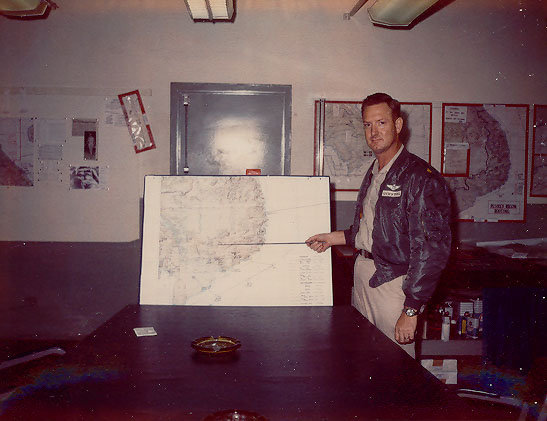
After several months of this activity, in the spring of 1968, I was reassigned to the 3rd Air Division on the island of Guam. I worked as a planner in the operations section. We had four crews of planners who worked 24 hours a day. One crew would work from 7 am until 4 p.m. and then the second crew would come on and work until midnight. The third crew would come in at midnight and work until 7 am. The forth crew would have off. I went to Guam alone and a couple of months later my family came to the island and we were a family again.
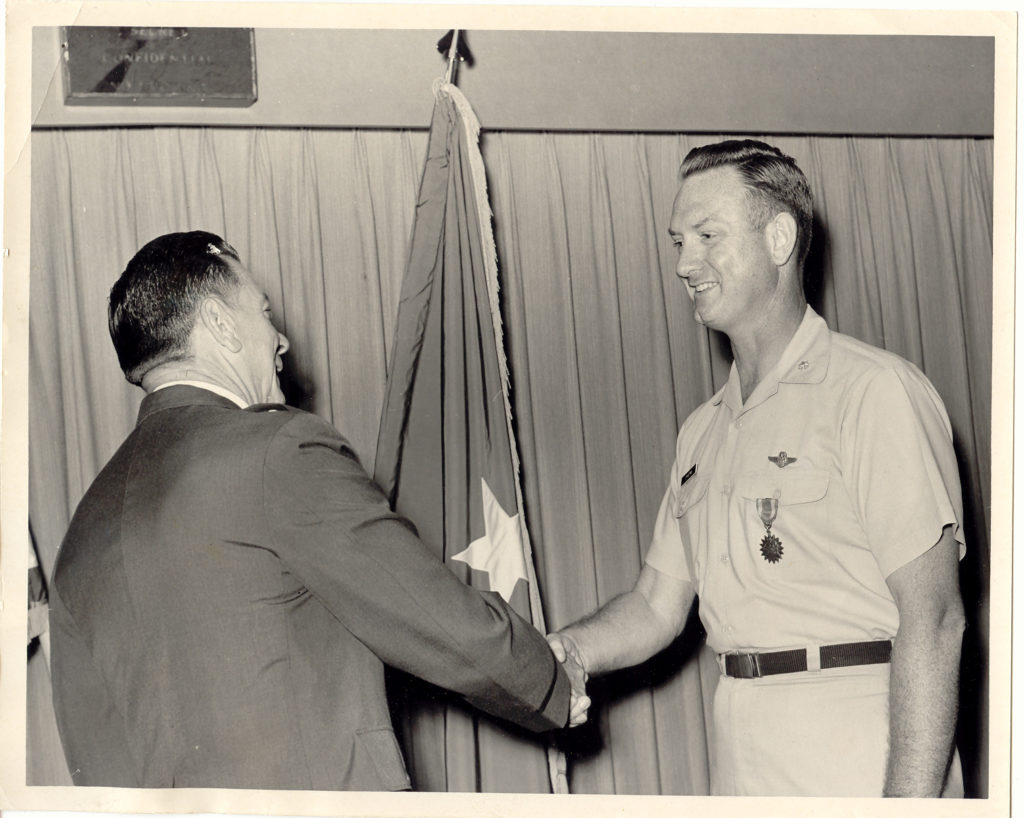
We lived and worked on Guam until February of 1970. Just prior to going back to the states I was assigned to be the briefing officer for the Operations Division and I would have to brief the General every morning as to the activity of the past day and night and brief him n the missions for the upcoming day. It was during this time that I had to brief the general on a controversial plan which was introduced by our counterparts in Viet Nam. He had been briefed on what they wanted earlier, and he rejected the plan thumbs down. We had revised the plan somewhat and cleaned up some loose ends, and presented it to General Gillum again. This time he agreed with us and put his stamp of approval on the plan. In February 1970 we moved from Guam to Offutt AFB in Omaha, Nebraska.
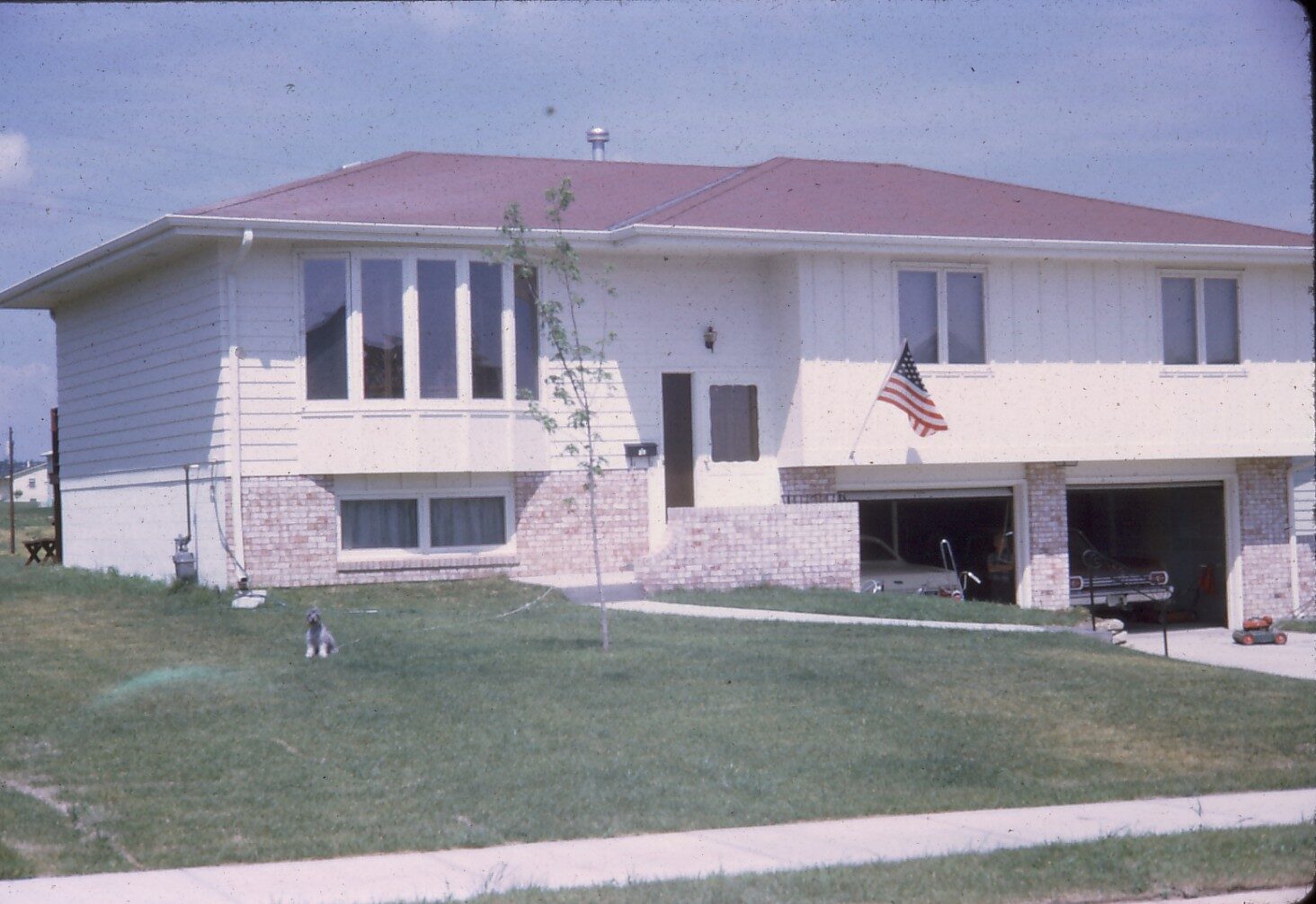
While stationed at Offutt, we bought a nice little house in Papillion, and all three of my children attended school in Papillion. Jeannie was a high school’er and the boys were in grade school.
It was in the summer of 1972 that my wife, and mother of my children, Barbara, died of a brain aneurysm. We buried her in Fort Walton Beach, FL, as that is where we planned to retire. Shortly thereafter I was made section chief in the operations division.
This was a fairly routine experience until the Christmas time in 1972. That is when we started bombing with B-52s in North Vietnam. The target that the commanders in Saigon wanted to be bombed would come to SAC Headquarters and then in coordination with the Intelligence Division we would plan the attacks and withdrawal from Hanoi and Haiphong. These targets would be briefed to the Commander of SAC and after we go his approval we would send the information to Guam so they could plan the route to the target area and the refueling. This was a hectic period because I would go to work in the morning and many nights I would still be there working on the mission at midnight.
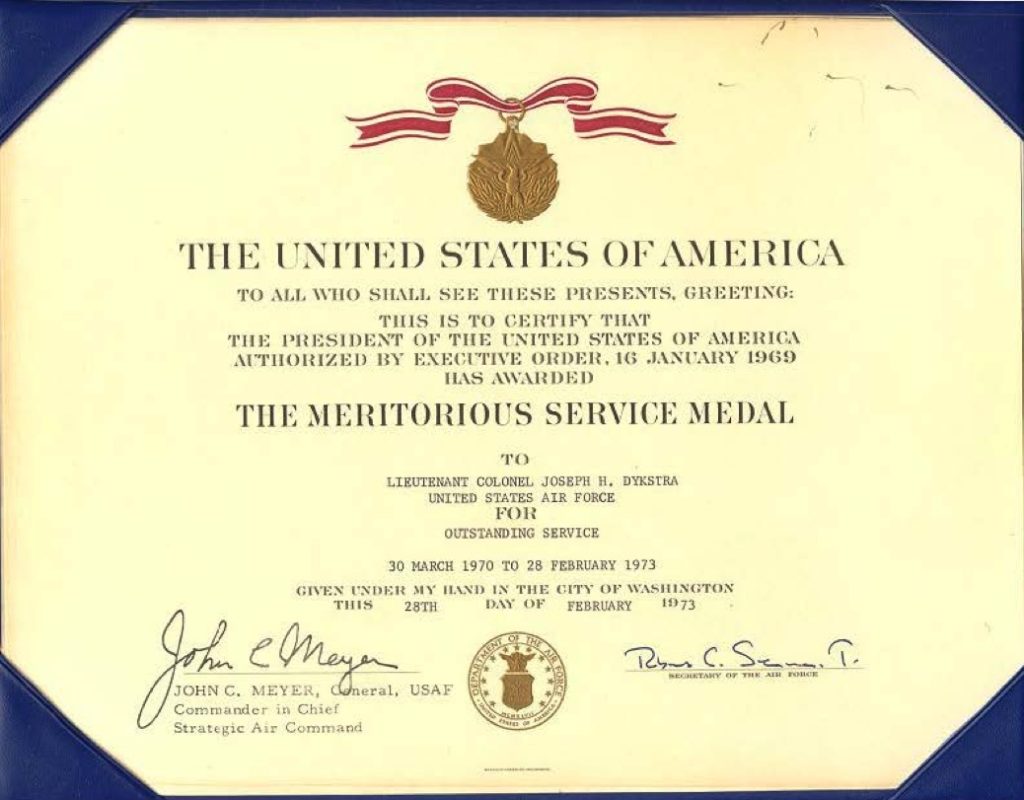
In the same time period, I met Eva Bergeron who had 4 children of her own. In the spring of 1973 I retired from the Air Force . Then Eva, her four children, me and my three children moved to Fort Walton Beach, Florida. We struggled financially for quite awhile, and finally I got a job working for a swimming pool company. Even then the pay wasn’t very good. Because of her illnesses, Eva could not stand the humidity of Florida, and so we moved to Arizona.
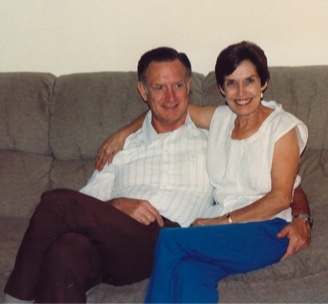
I was successful in obtaining work for Hamilton Test, the company that did emissions testing on the motor vehicles in Phoenix and Tucson. I worked for them for about 2 ½ years, when I found out that the state organization that oversaw the emissions testing program had an opening for a supervisor of the testing program. Since I was very familiar with the testing program I applied for the position and I was hired. I worked for emissions testing for about 2 years and then I was moved into the director’s office as an administrative assistant. Shortly thereafter our division was separated from the Health Department and was made into the Department of Environmental Quality. Because of my experience in budget development I became a budget control development specialist. I retained that title and job until I retired in 1992.
After retirement I spent some time traveling, mostly to New England, and the mid-west. After a couple of years, Eva’s health deteriorated and I spent much of my time taking care of her. On one of our trips to New England, in 2000, we attended my high school 50th reunion. I again met Natalie, who was now Natalie MacLean. We both felt that old heart rush, but because we were married and each to an ailing spouse we couldn’t do anything about it.
In January, 2005 I got back a Christmas card that I had sent to an old friend of my folks, she was 100 years old. Because it was returned as “Undeliverable”, I called Natalie, who I knew would know about Galdis. A short time later I heard from Natalie and she informed me that Gladis had died the year before. In talking to her I found out that her husband had died in December, and that she was going to Phoenix in February to visit her sister. By this time Eva was in the nursing home and suffering from dementia. I scheduled a meeting with Natalie at the sister’s house and we got back together. In April, Eva died and since we both were single again we got back together and have been ever since.
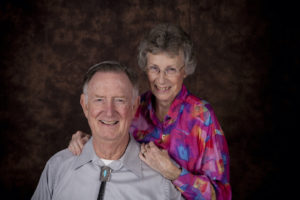
Natalie enjoys traveling and so do I and we have made several trips across the country from Arizona to New England in the motor home. We both enjoy the trips, and we both enjoy each other’s company. We both went through a lot when we were taking care of our spouses, and now we are enjoying the twilight of our years. We both hope that this will last a long long time.
NOTE: Dad and Natalie did enjoy many years together, but unfortunately not enough. My father died in Mar of 2015. My brothers and I took his ashes to be buried next to our mother in Ft. Walton Beach, FL.
