The first Generations of the Van Lew family
Generation 1: Frederick Hendrickson Van Leeuwen
Jamaica, Long Island • Arrived c. 1670
- Born c. 1640, Netherlands (Utrecht or Gelderland) [VERIFIED]
- Arrived c. 1670, Jamaica, Queens County, Long Island, New York [VERIFIED]
- Married October 2, 1681, to Dina Jans of New York [VERIFIED]
- Will November 19, 1712; proved June 9, 1726. Name spelled “Van Leau.”
[VERIFIED] - Property 1701 — purchased land in Middlesex and Somerset Counties, NJ
[VERIFIED] - Source Both published genealogies: Thomas L. Van Liew (1910); W. Randolph Van
Liew (1956)
Frederick crossed the Atlantic at a moment when the Dutch colonial experiment in America was already ending. Six years before his arrival, the English fleet had sailed into New Amsterdam’s harbor and taken the colony without firing a shot; Peter Stuyvesant wanted to fight but his own citizens refused. The colony Frederick entered still spoke Dutch, still worshipped in Dutch Reformed churches, and still farmed in the Dutch style — but its flag had changed. Jamaica on Long Island (Dutch: Rusdorp, “town in the country”) had been settled in 1656 under Governor Stuyvesant’s warrant. The Hell Gate strait between Manhattan and Long Island was treacherous — a violent stream with a whirlpool that, as one early account described, sent forth a hideous roaring. When Frederick’s will was proved in 1726, it mentioned an estate still held in Holland “if ever it be obtained” — a reminder that even after half a century in America, the family had not entirely left the Old World behind.
Generation 2: Hendrick Van Leeuwen
Jamaica, Long Island Somerset County, New Jersey →
- Born Jamaica, Queens County, Long Island [VERIFIED]
- Parents Frederick Hendrickson Van Leeuwen and Dina Jans [VERIFIED]
Hendrick’s generation crossed the Hudson into New Jersey, seeking farmland in the Raritan Valley. The valley offered what the Dutch farming tradition needed: fertile meadowlands, natural pasturage, and soil ready for the plow. The native Raritan people had already cultivated corn on these meadows. Somerset County was carved from Middlesex in 1688 because of this expansion. The Dutch Reformed Church at Six Mile Run became the community’s spiritual center.
Generation 3: Frederick Van Liew
Six Mile Run / East Millstone, Somerset County, NJ • 1694–1784
- Born April 30, 1694, Somerset County, New Jersey [VERIFIED]
- Died c. 1784 [VERIFIED]
- Married March 9, 1717, to Helena Denise [VERIFIED]
- Will Estate valued approximately $10,000 [VERIFIED]
- Children Dyna (1718), Helena (1721), Maritja (1724), Frederick (1727), Denice (1729),
Cornelius (1734), Johannes (1736) [VERIFIED]
Frederick and Helena had seven children. Several of these children appear in the church
records of the New Millstone and Six Mile Run Reformed Churches, where their baptisms,
marriages, and those of their grandchildren fill dozens of pages. The family’s presence in
this church spans three generations and at least sixty-four baptism records.
Helena Denise’s father, Jacques Denise, was a Huguenot ferryman at the Narrows who
drowned while crossing. This Dutch-Huguenot marriage confirms the intermingling of
refugee communities in colonial New Jersey. In 1766 — the same year Cornelius was named
a founder of the New Millstone church — Rutgers University was founded as Queens
College by Dutch Reformed ministers, just fifteen miles from the Van Liew farms.
Generation 4: Cornelius Van Liew
East Millstone / Middlebush, NJ • 1734–1777
- Born January 7, 1734, Somerset County, New Jersey [VERIFIED]
- Died January 29, 1777, New Jersey [VERIFIED]
- Parents Frederick Van Liew (Gen 3) and Helena Denise [VERIFIED]
- Married Antje (Ann) Bowman, at Three Mile Run, Somerset County [VERIFIED]
- Property ~350 acres, Millstone end of Lot #3, Harrison Tract [VERIFIED]
- Church Named as founder of New Millstone church (1766); member by
profession of faith (Jul 30, 1772). Wife Antje became a member in 1775.
[VERIFIED]
The Revolution on His Land
Source Both published genealogies; church records; NJ war damage claims
Cornelius held 350 acres stretching from the Millstone River half a mile wide, up the south
side of Amwell Road to halfway to Middlebush. The village of East Millstone and its church
stood on his land. He was named as a founder of the church in 1766. He died on January 29,
1777 — seven months after the Declaration of Independence, as the Revolution engulfed his
community.
After Cornelius’s death, the war came directly to the family’s door. British General Howe
threw up forts on his brother Denice’s farm. Cornwallis encamped on the 350 acres with
two full divisions. The family was driven from their home. Cattle were confiscated. Hessian
soldiers took bread from ovens and food from tables. Soldiers chopped meat on the old
Dutch kitchen cupboards; the nicks in the wood “were objects of curiosity for many years
afterward.”
Washington twice encamped his army at Middlebrook — the same ground — in June–July
1777 and again in the winter of 1778–1779. The Van Liews did not just fight in the Revolution;
the Revolution literally camped on their land. At least ten Van Liews served. After the Battle
of Trenton (December 26, 1776), Van Liew patriots extended their enlistments for two
additional weeks. The New Jersey Legislature partly reimbursed the family by special act in 1781.
Seven Children — Where the Trail Goes Cold
The church records of the New Millstone Reformed Church document seven children of
Cornelius and Antje. The following baptisms were verified directly from the original
register (Ancestry Collection 6961, Book 76)
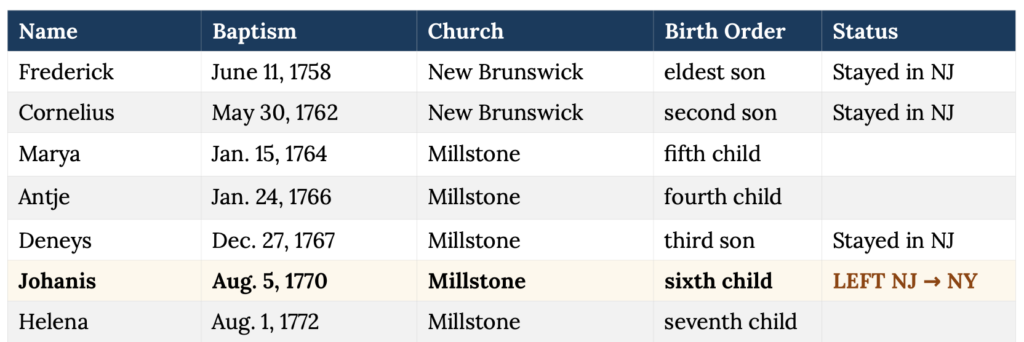
Both published genealogies’ coverage of these children ends at baptism. Neither traces a single one into adulthood.
“Beyond the baptismal records of Cornelius’ children, the Author has been unable to trace any ensuing descendants.” — W. Randolph Van Liew, 1956