A Holm-spun story
From the windswept coast of western Finland to the silver mines of Colorado, the story of Charles Holm and Johanna Erickson is one of courage, hardship, love, and endurance. Their journey reflects the experience of many Scandinavian immigrants who left behind poverty and rigid social expectations in search of opportunity in America’s West.
Charles J. Holm was born on May 8, 1866, in the small coastal community of Närpes, Finland. Just a few months later, on October 17 of the same year, Johanna Eliza Erickson was born nearby and received her education in a private school. Though they came from the same region, family stories differ on how they met. One version says Johanna came from a more educated family and was discouraged from marrying Charles, who worked as a laborer. Another family story says they met aboard the emigrant ship carrying them to America. Either way, by 1886, both young people had made the life-changing decision to leave Finland behind forever.
In 1888 they arrived in the United States and made their way west to the booming silver mining town of Leadville, Colorado. At the time, Leadville was alive with opportunity and danger. The mountains surrounding the town were filled with mines, and immigrants from all over Europe crowded into rough boarding houses and small wooden homes, hoping to build a better life.
Charles quickly found work in the mines. City records show that in 1888 he lived at 405 East 2nd Street, likely in a modest miner’s boarding house or rented room near the center of town. That same year Charles and Johanna were married in Leadville, surrounded by members of the local Scandinavian community who had also traveled far from home to carve out new lives in the Rockies.
The Scandinavian immigrants of Leadville formed close communities, helping one another survive the harsh realities of mining life. Charles and Johanna probably attended the Swedish Lutheran church on Main Street between 2nd and 3rd Streets. The church would have been more than a place of worship — it was where families gathered, shared news from home, spoke their native language, and held onto traditions from Finland and Sweden while adapting to life in America.
On May 26, 1888, Charles and Johanna were married in Leadville by minister August Johanson, witnessed by fellow Scandinavians Charles and Mrs. Bergstrom. Johanna was listed as “Hini,” a reminder of how immigrant names often changed in American records.
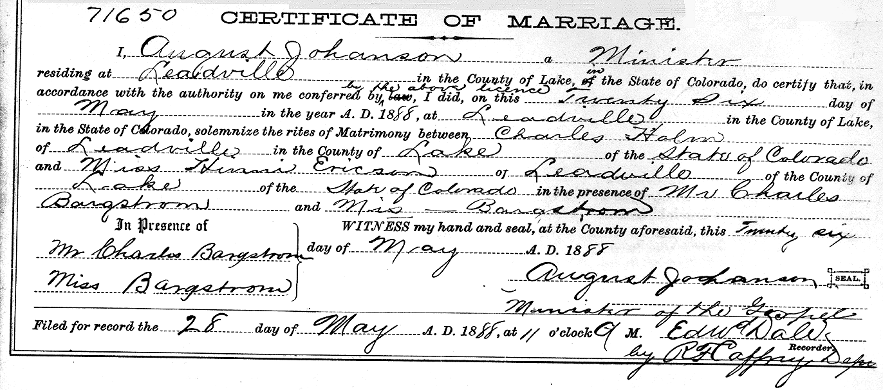
By 1889 Charles had moved closer to the mines themselves, living near the Smuggler Mine on North Side Street. Mining work was unpredictable, and families often moved wherever jobs could be found. Later, by 1892, the Holms were living at 230 East Main Street. No deeds were ever found for the property, suggesting they rented their homes as they followed the shifting fortunes of the mining industry.
Life in Colorado’s mining camps was difficult. Miners worked long hours underground in dangerous conditions filled with dust, unstable tunnels, and constant risk of injury. Still, Charles continued building a life for his growing family. In 1894 he worked for the Union Leasing and Mining Company and lived at the east end of Strayhorse Road above the Robert Emmet Shaft. This isolated mining settlement was known as “Finntown” because many Finnish immigrants lived there near the mines. Small homes and miner cabins dotted the hillsides, creating a little piece of Finland in the Colorado mountains.
Life in the mining camps was never easy. Charles worked as a miner, frequently moving between Leadville and Aspen following whatever work was available. City directories show him living in boarding houses and miners’ neighborhoods, often alongside other Scandinavian immigrants.
As their family grew, so did the hardships they endured. Children were born during uncertain times, often without official birth records. The Holms experienced both joy and devastating loss. Little Ester died in 1894 at only three years old and was buried in an unmarked grave in Leadville. Another infant was stillborn the following year.
Yet the family persevered.
Despite the hardships, Charles and Johanna were determined to put down roots in America. Charles declared his intention to become a United States citizen, and on August 3, 1896, both he and Johanna were officially naturalized in Leadville, Lake County, Colorado. They were both thirty years old. A man named Joe Holm served as Charles’s character witness during the proceedings, though exactly how he was related to the family remains a mystery lost to time.
As the 1890s began, life in Leadville was becoming increasingly uncertain. The great silver boom that had once made the town one of the richest mining centers in America was beginning to falter. Mines slowed production, jobs became harder to find, and many mining families were forced to follow work wherever it appeared. For Charles Holm, that search for opportunity may have led his family across the Continental Divide to the growing mining town of Aspen.
Aspen, like Leadville, had been built on silver. Tucked high in the Rockies, it was still young in the early 1890s, with muddy streets, wooden buildings, and neighborhoods that spread outward from the busy downtown core. One of those areas was known as Oklahoma Flats, sometimes called the Swedish Section because so many Scandinavian immigrants settled there. In those days, the area was still sparsely developed, with only a scattering of small homes, open land, and a few dairy farms along the edge of town.
A deed dated June 1892 records the purchase of Lots K and L, Block 5 in East Aspen for $500 by Charles Holm and others. This may well have been property in Oklahoma Flats, suggesting that Charles and Johanna were beginning to establish more permanent roots in Aspen even while mining work remained unstable. The purchase represented a major investment for a miner’s family and hints at their determination to create a home despite uncertain times.
Yet the records also tell a confusing story — one that reflects the transient nature of mining life in Colorado. During the same period Charles still appears in Leadville records connected to mining work and residences there. It is possible that Charles moved Johanna and the children to Aspen while he traveled back and forth between Aspen and Leadville in search of employment, perhaps renting a room or small apartment near whichever mine was hiring at the time. Such arrangements were common among miners whose work was seasonal, temporary, or dependent on the success of individual claims.
The silver crash of 1893 devastated Colorado mining communities. Mines closed, jobs disappeared, and Aspen’s prosperity faded almost overnight. Charles spent much of his life enduring periods of unemployment caused by flooded shafts and failing mines. Still, the family remained in Aspen’s Scandinavian community, in an area known as Oklahoma Flats, where many immigrant miners settled.
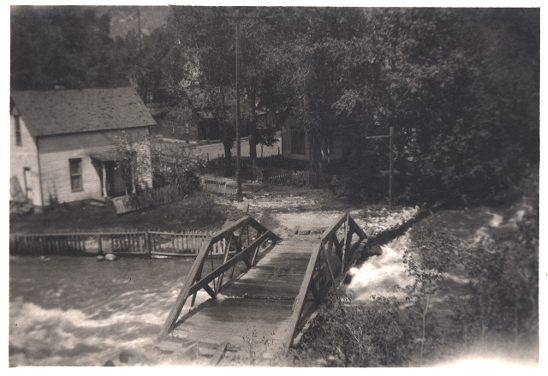
By 1900 the Holms owned their own home in the Aspen area, a remarkable achievement for a miner’s family. The census paints a vivid picture of their household: Charley, unemployed for part of the year because of unstable mining conditions, and Johannah caring for five surviving children after giving birth to seven. In 1914 Charley purchased another property at 135 W. Francis for $500. The family remained in this home until their son Edwin sold it in the 1940’s.
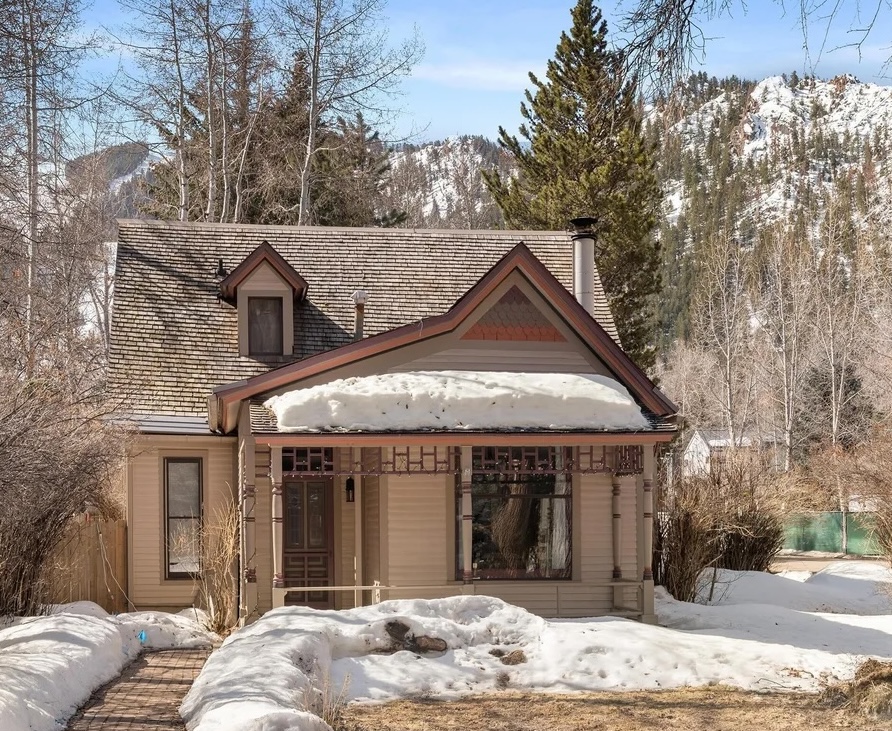
Johanna’s strength shines quietly throughout the family story. She raised a large family through poverty, uncertainty, and repeated tragedies. By 1910, census records showed she had given birth to twelve children, though only eight were still living.
The Holm children slowly began building lives beyond the mines. Ellen became a schoolteacher. Escal worked as a machinist. Edwin served during World War I. Ivan eventually moved to Los Angeles, reflecting the westward migration of many younger Americans seeking new opportunities outside dying mining towns.
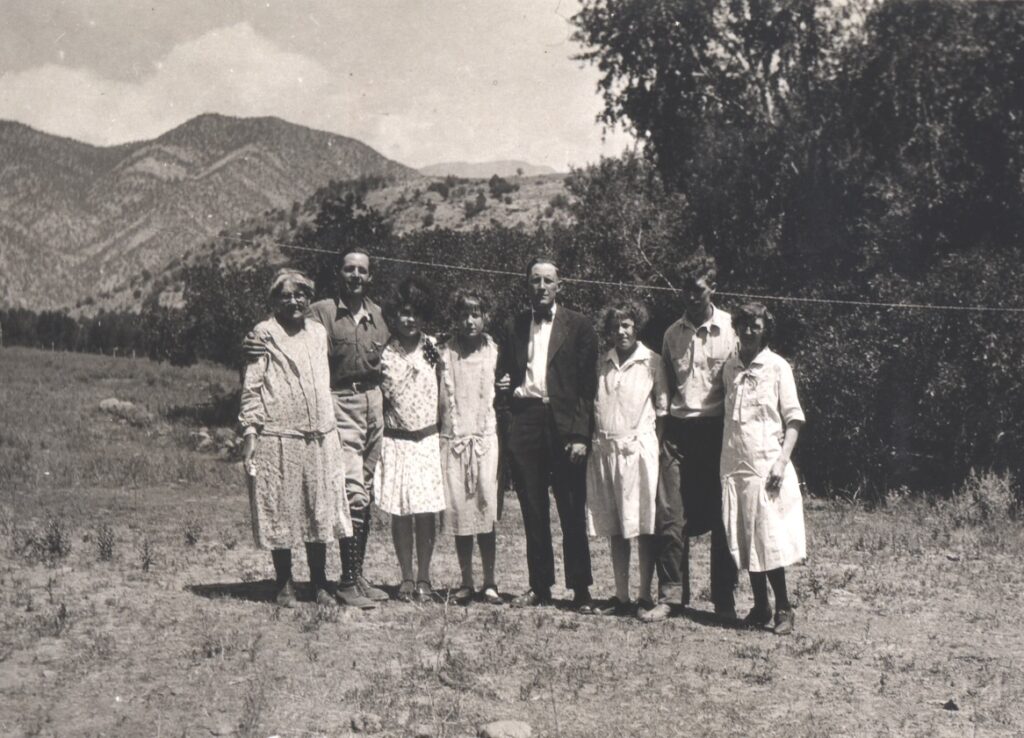
Johanna, Ivan and Pauline Holm, then the twins Ruth and Rose on either side of Carl Edwin, then possibly Richard and Viola Holm
Even as Aspen declined during the early twentieth century, the Holms held onto their home on West Francis Street. Charles continued mining well into old age, despite years underground damaging his health. On August 20, 1926, at the age of 60, Charles J. Holm died from “miners’ consumption,” likely silicosis or another lung disease caused by years of breathing mine dust. His obituary stated that he was known as one of Aspen’s best miners and was widely known and highly esteemed. He was buried in Aspen’s Red Butte Cemetery.
Johanna survived him by nearly thirteen years. One of Johanna’s grandchildren remembers calling her “Bangy” and they would sit around the kitchen table at Christmas, wrapping candy and other gifts to be sent back to family in Helsinki. After a lifetime marked by immigration, hard labor, childbearing, grief, and resilience, she died on June 7, 1939. She too was buried beside Charles in Red Butte Cemetery.
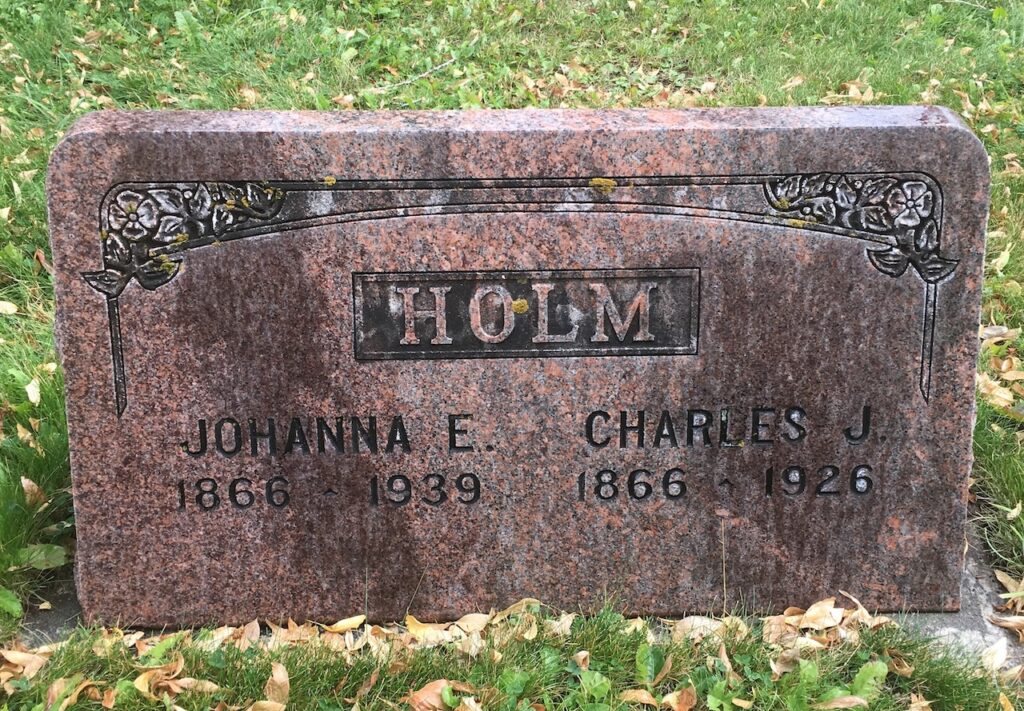
Their story is not one of wealth or fame. It is the story of ordinary immigrants who built lives through sacrifice and determination. Charles and Johanna crossed an ocean, survived the uncertainty of frontier mining towns, raised a large family through boom-and-bust economies, and laid the foundation for generations that followed. Their descendants inherited not riches, but something perhaps more enduring: perseverance, adaptability, and the courage to begin again in a new world.