The Expulsion — How the Heinz Family Lost Their Home
For generations, the Heinz family lived in the quiet rhythm of rural Bohemia. Their world was the village of Langlamitz, a German‑speaking community tucked into the northern hills of the Sudetenland. Life there was simple and steady: the farm, the seasons, the church, the neighbors, the land. It was a world built slowly, over centuries, and it felt permanent.
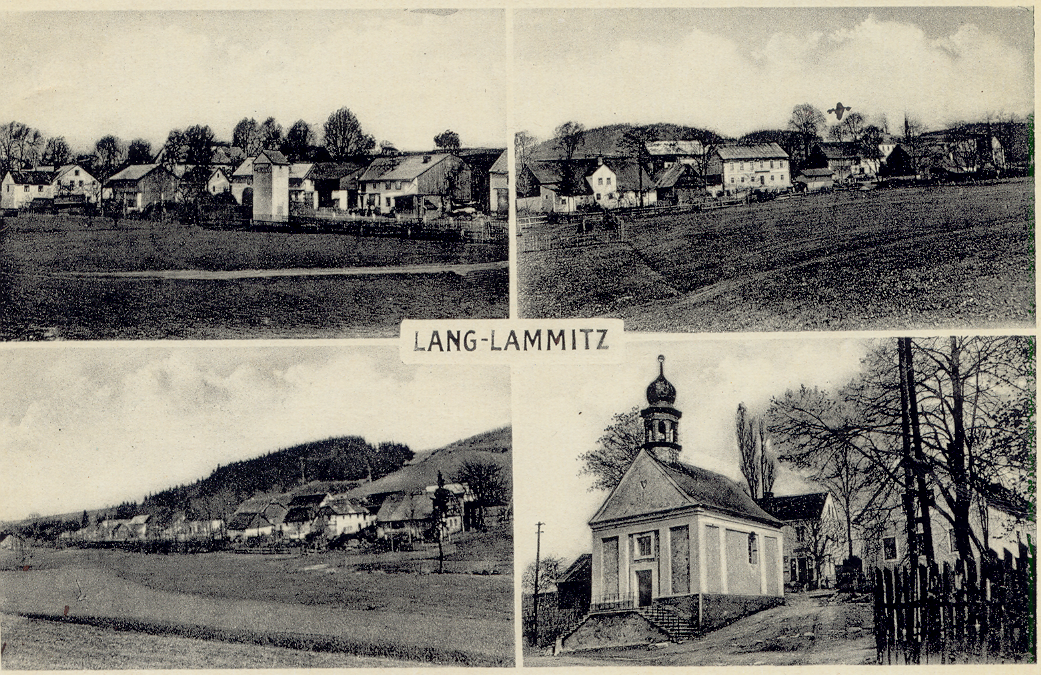
And then, in 1945, it ended.
When the Second World War collapsed, the borders of Europe shifted violently. The Czechoslovak government — with the approval of the Allied powers — ordered the removal of nearly all ethnic Germans from the country. It did not matter that families like the Heinz had lived there for hundreds of years. It did not matter that they were farmers, not soldiers; parents, not politicians. They were German, and that alone was enough.
The Heinz family was among the millions caught in this upheaval.
In the letters that survived — especially the legal correspondence from 1953 — the story appears in quiet, almost modest lines. Sigmund Heinz had managed the family farm, Landwirtschaft Nr. 3 in Langlamitz, since the early 1920s. The farm had been purchased in 1922 by his brother‑in‑law, Frank Massopust, who emigrated to America. Sigmund stayed behind, working the land, raising livestock, tending the fields, and keeping the family rooted in the soil that had always been theirs.
But in 1946, the expulsion reached Langlamitz.
The family was forced out with almost nothing. Their livestock, tools, equipment, furniture, and savings — everything that made a farm a farm — were confiscated. The 1953 attorney’s letter states plainly that “das gesamte lebende und tote Inventar verlorengegangen” — all living and dead inventory was lost. The phrase is stark, but behind it lies the collapse of an entire way of life.
They were loaded onto transport routes heading west, part of the long columns of refugees moving toward a Germany that was itself in ruins. Some walked. Some rode in overcrowded trains. All carried the same mixture of fear, exhaustion, and disbelief. They left behind not only their homes, but the graves of their ancestors, the orchards they had planted, the barns they had built, the fields they had plowed since childhood.
They left behind their world.
When they arrived in Germany, they were strangers in a country they had never lived in. They were placed in refugee camps, schoolhouses, barns, or whatever shelter could be found. They had no documents, no property, no legal standing, and no certainty about the future. They were simply “expellees” — Vertriebene — one of the largest displaced populations in modern history.
But the Heinz family did what so many families did: they began again.
By the late 1940s, they were resettled in Hessen, in the American occupation zone. The family split into two nearby towns:
· Bleidenstadt, where Franz, Sigmund, and later Marie lived
· Runkel an der Lahn, where Josef settled
The distance between them was small — only about 22 miles — and this closeness helped them rebuild the family network they had lost in Bohemia.
Life in Hessen was not easy. Housing was scarce, wages were low, and the trauma of the expulsion lingered. Franz worked twelve‑hour shifts in a printing factory, breathing lead fumes because it paid more than his trained profession as a baker. Sigmund struggled to file compensation claims for the lost farm, navigating the new German restitution laws. Marie and Josef lived modestly, often helping each other through illness, grief, and financial strain.
Yet through all of this, the family held together.
They wrote letters — long, emotional, deeply human letters — to their sister Antonia (“Toni”) in America. They sent photographs of their children, shared news of births and deaths, and leaned on her for comfort and support. Toni’s help, Franz wrote, was something they “carried on their own bodies,” a phrase that reveals how deeply her love reached across the ocean.
The expulsion did not break the Heinz family.
It reshaped them.
It pushed them from the fields of Bohemia to the hills of Hessen.
It forced them to rebuild their lives from nothing.
It bound the siblings together in a new way — through letters, through memory, through the shared experience of loss and survival.
And it left behind a story — a story of resilience, courage, and the quiet strength of a family that refused to disappear.